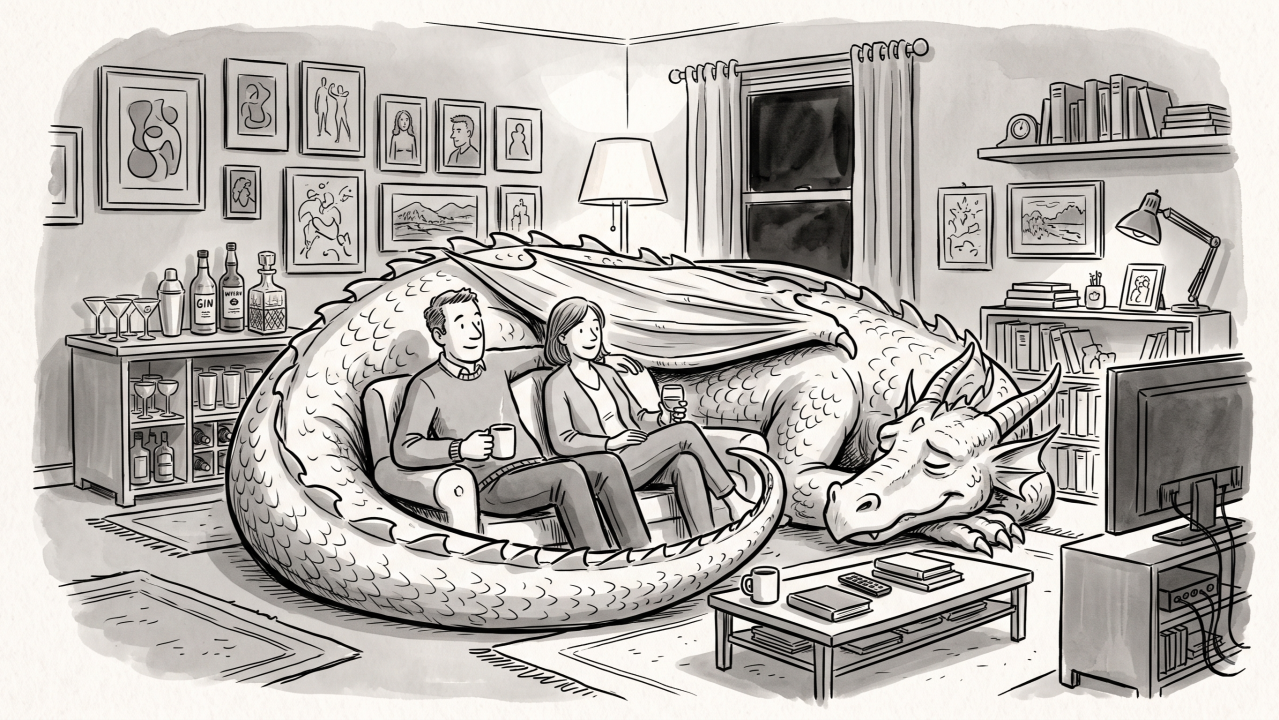
Christi and I bought a house.
I walked in and wondered whether our furniture would fit. Christi walked in and thought about how our blended family would experience our home. Then she set about making it one.
I watched her do it, in awe, and offered the best I could, muscle. I did not really understand what she was doing until I walked into our bedroom and felt that it was somewhere I wanted to lay my head and wake up, rather than a room containing a bed and a dresser for my clothes.
As we went from room to room, Christi (thank goodness) wanted to feel each one. She wanted to be able to exhale in it, knowing that it evoked us, our feelings and our experiences.
This is to say that Christi has taste I will never have and approaches transforming a house into a home very differently than I do.
My approach is furniture in, job done, moving on. What I have learned, gratefully, is that creating a home is never really finished. We continue to tweak it room by room (I am using we liberally here). We look at the current state of each room, recognize what it still needs, and add art and photographs placed just so. We are creating cwtch.
No, that is not a typo. Cwtch is a Welsh word meaning both a hug and a place of safety. It is the feeling you get when you walk into a room and know that it is right.
We knew what each room was supposed to do. The bedroom needed to be dark enough that the morning sun would not wake us. The family room needed to bring everyone together to watch the latest episode of whatever show we were all raving about. Cwtch was how we knew we had done it.
It took me this many days alive to realize how awesome that process is.
The closest thing to this in business is labelled a transformation (continuous improvement is also bandied about, but transformation seems to be the sexy label). Transformation is defined as a thorough or dramatic change in form or appearance. The word dramatic is always fun, I have been accused of being overly so on more than one occasion. The Latin it comes from (first showing up in English in the 1400s if you want to know) comprises the words across and to form. This might be the issue with using the word, we drive to form rather than shape.
Furniture in, job done. Model deployed, job done. Neither one creates cwtch.
Nearly every organization is trying to add AI to its transformation. McKinsey's The State of AI in 2025 (opens in a new tab) reports that 88% of organizations use AI in at least one business function.
What differs between success and failure is whether they redesigned the work itself, and only 21% of those using it have. That means deciding what the work is for, which is another way of saying somebody had a vision for it. Only 6% are getting real money out of AI.
A 2025 report from MIT's Project NANDA (opens in a new tab) found that 95% of the enterprise generative AI pilots it examined produced no measurable impact on profit and loss. The barrier was not model quality, regulation or talent. It was learning. Adapting might be the better word. The systems did well in demonstrations, then stalled when they met people doing real work in real organizations.
Every hyperscaler publishes an approach to this. Microsoft has one for partners and one for customers based on how it transformed itself, Google has an AI Adoption Framework, AWS has CAF-AI. They are worth reading, and absolutely not wrong. Bar AWS, they are built to measure capability, which is useful but sets an end point for AI maturity, not for vision. They focus on the solution, not the problem.
In our house the destination never moved. The bedroom needed to be dark. What changed was the room, not the vision.
Here is how I would approach it.
Start with one part of the business and define what needs reshaping. What is slowing it down, what needs to change to optimize it, what is its mission. Then define what good looks like, and what the people doing the work should feel when it works. That is the vision.
Then ask where AI helps, which really has two answers. There is the journey, where AI is the muscle. It is the fastest way to try things, to see what the work looks like rearranged, to do in a morning what used to take a quarter. And there is the destination, where AI is part of the work itself, running inside it every day.
After that it is just looking at the current state and finding the next adjustment. You will know when you feel cwtch, and if you don't, tweak it. Success is embedding this process as a practice, and treating transformation as continuous, not fixed. Get this process right and you can rinse and repeat across your entire business.
I am grateful to Christi for teaching me this. She had a vision for each room and the patience to keep adjusting until we could feel it.
AI can finish a room. It cannot realize a vision.
If you want to go deeper
McKinsey, The State of AI in 2025 (opens in a new tab). Where the 88% and the 6% come from, and what separates the two.
MIT Project NANDA, The GenAI Divide: State of AI in Business, 2025 (opens in a new tab). The 95%, and why they put the barrier down to learning rather than to the technology.
Microsoft, AI Transformation Partner Playbook and the Frontier Firm IT playbook. Google Cloud, AI Adoption Framework. AWS, Cloud Adoption Framework for AI. All three are worth your time. AWS is the one that starts from the business outcome and works backwards, which is closest to what I am arguing here.
Jackson et al., Emotion semantics show both cultural variation and universal structure, Science, 2019 (opens in a new tab). They mapped emotion words across 2,474 spoken languages using colexification, which is when a language names two related concepts with the same word. Cwtch is exactly that, one word for a hug and for a place of safety. Emotion words vary a great deal between language families, while every family still sorts them along the same two axes, how pleasant a feeling is and how activating it is.
Tim Lomas, Towards a positive cross-cultural lexicography, Journal of Positive Psychology, 2016, and the book Translating Happiness, MIT Press, 2018. He went looking for words about wellbeing with no direct English equivalent and found 216 to start with. The list has since run past 600, from 72 of the world's 7,000 languages. For the Welsh rabbit hole, cwtch and hiraeth are the pair worth reading. One is the feeling of being safely inside a home, the other the longing for one you cannot return to.
Shelley Mallett, Understanding home: a critical review of the literature, The Sociological Review, 2004. She asks whether home is a place, a space, feelings, practices, or an active state of being in the world.