TL;DR: Anyone can vibe code an app now, but most of what gets built goes nowhere. Inside a company, on a shared foundation of context, it makes sense: software built for what is needed now, retired when it no longer fits, with people still at the center.
Everyone can build now
It is now possible to rebuild some of the original SaaS platforms using AI. Brandon Thomas, an experienced engineer, used AI to release open-source counterparts to seven Adobe applications, and has copies of Word, Excel and PowerPoint underway. GenOffice, built by a single developer, has released its own alternative to Microsoft Office. These are not mature replacements for products developed over decades. What matters is that one person can now build something recognizable enough to invite the comparison.
Where we used to say "how do we do this in Salesforce, SAP or Microsoft?", we are now increasingly saying "I built this using (insert your AI coding tool of choice)." Vibe coding has gone mainstream. GlobalData has tracked rising vibe-coding job postings across technology, retail, financial services, healthcare and media.
Now, some of the things being built are as secure as a house with all the doors and windows wide open, and are open invitations to hackers and the other nefarious people hanging around the internet. Security firm Escape.tech scanned 5,600 publicly available vibe-coded applications and found more than 2,000 high-impact vulnerabilities, over 400 exposed secrets and 175 instances of personal data exposure.
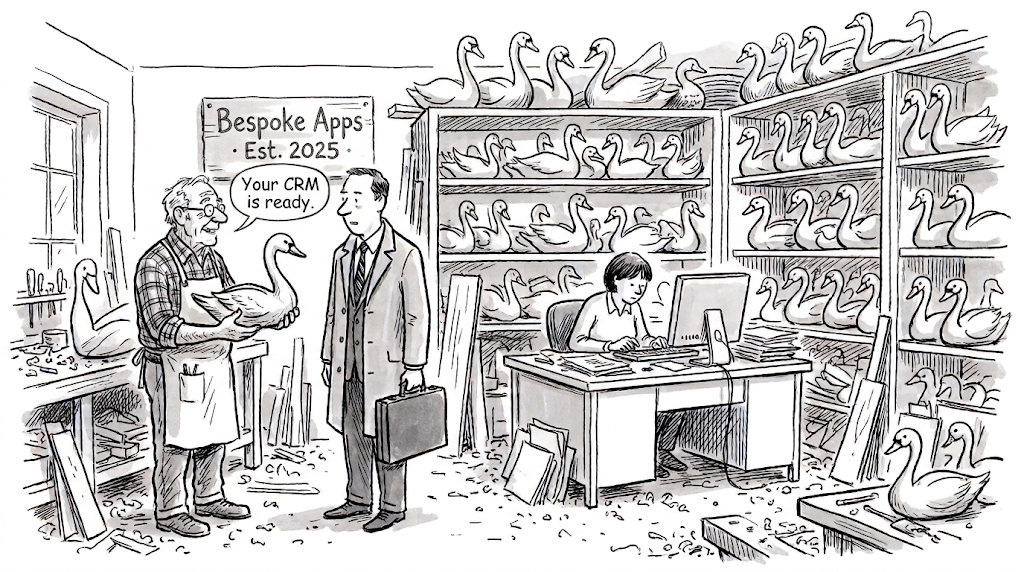
To me, vibe coding is like that guy who can whittle amazing swans from a small piece of wood. An amazing display of talent, but that swan is going to sit on a shelf and get talked about every few months when someone notices it. The act of doing it is the amazing part, not the finished product beyond a "wow, that's amazing."
I respect anyone who can whittle wood, and I respect anyone who can vibe code an app with prompts, so please don't get me wrong. Both are impressive feats, and most of what comes out of vibe coding is a swan on a shelf. The numbers back that up:
- Greta is an AI app builder that turns a prompt into a hosted web app. By its own data, only about 4 in 10 apps ever built on it reached a live URL.
- Bolt runs a full development environment in the browser, so anyone can describe an app and have AI build it. Its CEO calls very high customer churn the problem everyone in vibe coding has.
- Lovable is a Stockholm-based platform where people build websites and apps by chatting with AI. Barclays analysts found its traffic down 40% by September 2025, though its CEO says paying users are spending more over time.
WAIT, there is some gold in all this negative data.
Bolt's weak retention was among consumers building personal projects. Where it found classic business-software retention was with product and development teams inside companies, building against their own code, design systems, workflows and data. Most swans are built alone: no shared data, no rules, no one checking the work and no one using it the next day.
That is the gold. Vibe coding on its own makes swans. Vibe coding inside a company, on a shared foundation, makes sense.
Requirements were frozen because software was expensive to change
Vibe coding solves the major problem we have always had with enterprise software. Implementing large ERP systems has always followed one of two models: either you change your processes to fit the software, or you change the software to fit your processes (most solution integrators call that a whale). In both cases, companies had to drive major initiatives to rework the business to fit.
Traditional enterprise software tries to predict the future while protecting the present. Before building begins, we decide what users will need, which workflows will persist, which questions people will ask and how the data should be displayed. Those assumptions become requirements, and the requirements become an application. Months or years later, users receive exactly what was needed months or years ago, not what is needed today.
Vibe coding changes the expected lifespan of software. If it is cheap to build, it is cheap to try. So why not embrace that: deploy faster, iterate as the business changes, and retire what no longer fits? We don't have to build software based on requirements from years ago. We can build it based on what is needed right now.
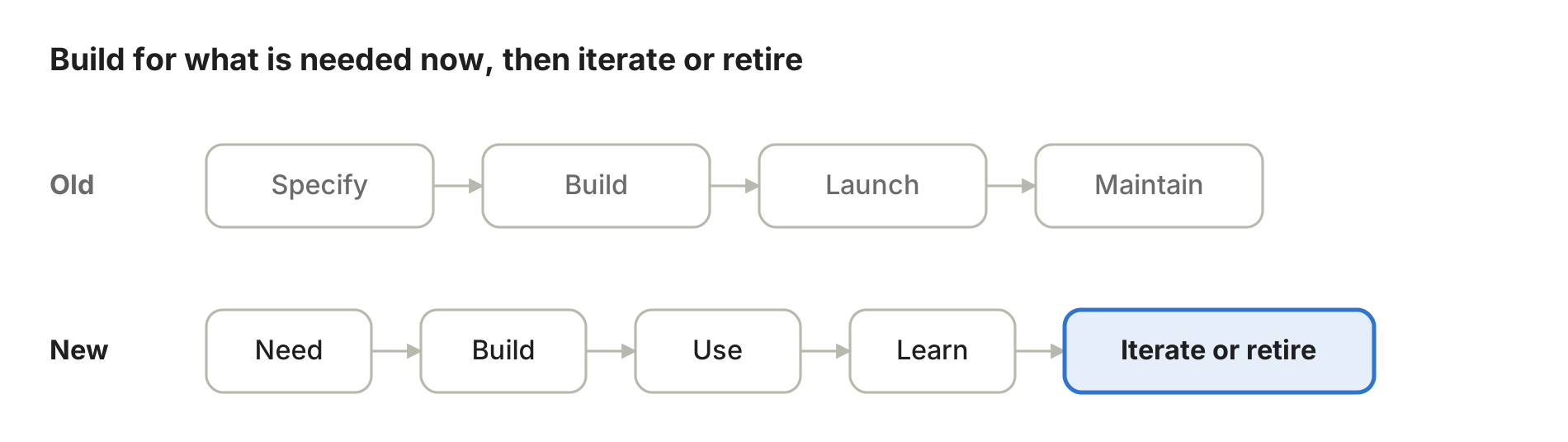
The retire part matters. We should be comfortable throwing software away, and build an organization that can continually produce the software it needs now.
If the software is temporary, what must remain?
The company cannot be regenerated from scratch every time someone needs a new application. Its customers, people, contracts, policies, history, permissions and relationships need continuity. That is the durable asset: the company's context.
Today, too much of that context is trapped inside applications (AKA systems of record). Salesforce holds one part of the company's reality, SAP another, ServiceNow another, and documents, spreadsheets and employees hold the rest. We treat applications as the place where company knowledge lives because, historically, we had no better option.
Reverse that. Build the context independently and let software consume it. The application is then one way of seeing or acting on the company, rather than the container holding it.
Context is what stops AI from guessing
If I ask AI three times to help me cross the street, I may receive three different answers: find a crosswalk, wait for a signal, avoid the road entirely. AI is filling the missing information with assumptions.
Now I tell it that it is Sunday morning. I am standing at a marked crossing on a one-way street. Visibility is clear, the road is freshly paved and there are no cars approaching. The wording may still vary, but the recommendation should stay consistent. That is context: enough understanding of the situation for AI to stop guessing and give a dependable answer.
The same is true inside a company. AI needs to know what the data means, how things relate, which rules apply, who is asking, what that person is permitted to do and what outcome is needed.
Build the shared context
Context is scattered across databases, applications, documents and the experience of employees. The opportunity is to bring it together into one shared foundation: trusted data, common business meanings, the relationships between customers, products, orders and events, policies, permissions, approved actions, and examples of how similar situations were handled.
The data stays alive as customers, prices, inventory and conditions change. The foundation makes sure the changing data still means the same thing across the organization. AI turns that foundation into a decision for an operations manager, a customer response for an account manager or a view for leadership, and turns human intent back into an action the company can execute safely.
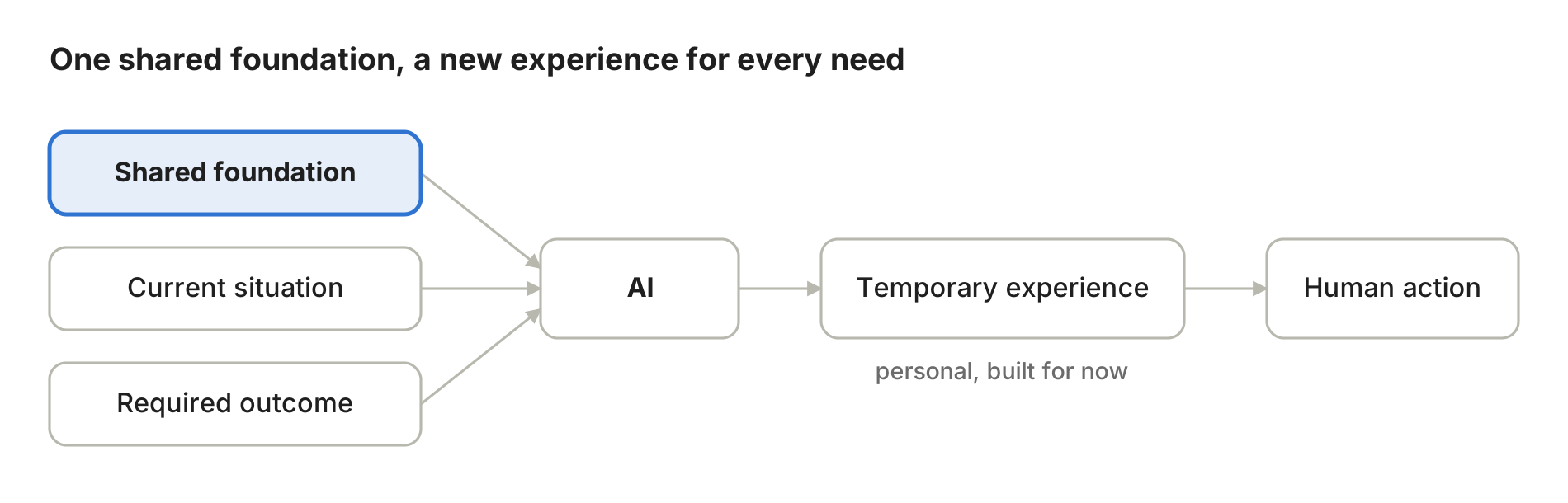
The UX is personal. The foundation is shared.
This changes what "build me an app" means. You do not ask AI to invent an expense system from nothing. You ask it to give a particular group of people a useful way to work with expenses. The policies, people, data, permissions and history already exist, and AI composes an experience around them.
Finance might get a grid, an executive a summary and a chart, and someone in the field three buttons. An agent may need no screen at all. Different people can get different software without getting different versions of the truth. The interface is personal, but the facts, definitions, rules and permitted actions are shared.
Ship use cases, not monolithic applications
Shipping skills rather than full apps is the future: slices of functionality that can be included in vibe coding. Start with a specific problem, decision and outcome. Explain why this shipment is delayed. Decide whether this claim needs escalation. Show which customers an inventory change affects.
These do not need to become permanent applications. AI can assemble each one from the shared foundation and a set of approved actions: retrieve a price, check eligibility, open a case, escalate an exception. If the use case works, its pieces get reused. As the value of that slice diminishes, it can be removed or revamped to fit the current reality, without touching the foundation.
The same goes for dashboards. A dashboard is a frozen set of questions: someone decided which metrics would matter and how future users would need to see them. With AI, the question can stay alive. Instead of navigating a dashboard designed around yesterday's requirements, someone can ask, "Why did fulfillment costs increase in the Northwest this week, and which customers are affected?" AI pulls the relevant data together, applies the company's definitions and permissions, builds a view and explains the evidence. That view might exist for one meeting and then disappear. Dashboards still matter for monitoring, regulatory reporting and shared metrics, but they no longer need to be the default way into the data.
What needs to be in place?
Cheap software cannot mean every generated experience gets direct access to everything. The safer and more governed the foundation is, the more freedom people can have to build on top of it.
Organize and protect the data. Connect authoritative sources and set ownership, quality, freshness, permissions and lineage.
Capture shared context. Write down what things mean, how they relate, which rules apply and what actions are allowed. AI may generate an answer. It should not invent what "revenue," "customer" or "risk" means.
Expose reusable capabilities. Make approved business actions available as small, governed building blocks that AI can assemble into use cases.
Check the work. AI can verify output if the context is there, just like a senior person in the organization could check it, because they have the experience of working in the company or industry. Add automated tests, security scanning, access controls, audit trails and human approval where the consequences matter. Veracode found that AI models introduced a known security flaw in 45% of its benchmark coding tasks. Fluent output is not verified output.
Store the experience in SLMs. Small language models hold what the organization has learned: examples, decisions, exceptions and how similar situations were handled. Gartner predicts that by 2027, organizations will use small, task-specific models at least three times as much as general-purpose language models.
Put builders close to the work. The whole point is to get closer to the user as a developer. Domain experts, forward-deployed engineers and platform teams work together where the problem occurs. Fortune reports that forward-deployed engineer postings rose more than 1,000% from January through August 2026, compared with the same period a year earlier.
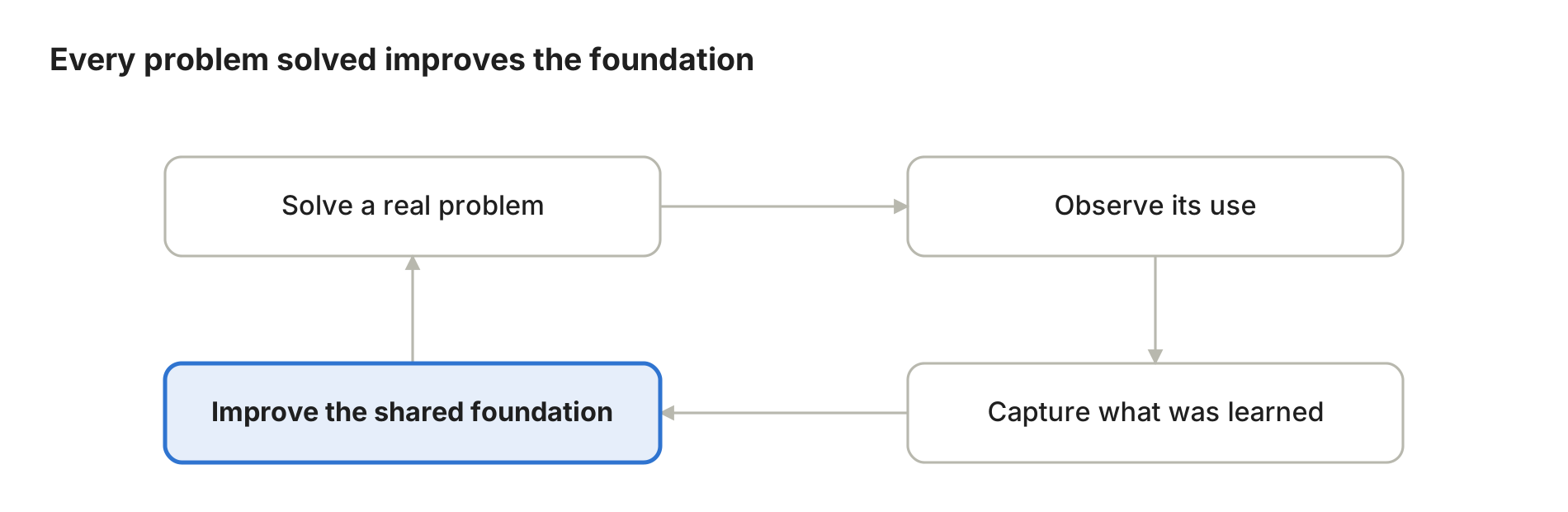
The model is not the asset
Models, coding tools and interfaces will keep changing. The company should own the context those things operate against. Which leaves the hardest question: if the software becomes temporary, what happens to the people?
The platform that endures
Most people are asking the same thing: will AI take my job? The evidence is mixed. Through September 2026, AI was the leading reason employers gave for announced US job cuts, cited in about 21% of them, according to Challenger, Gray & Christmas. Yale's Budget Lab has found no clear evidence of broad labor-market disruption from AI so far, and Stanford found the pressure concentrated on workers aged 22 to 25 in highly AI-exposed jobs.
What is clearer is that replacing people is not working. Only 21.4% of HR leaders surveyed by Careerminds said AI fully replaced eliminated roles without operational problems, and more than half said it needed more human insight than expected. AI does not decide which customers matter, which trade-offs are acceptable or which problems are worth solving, and it does not carry relationships or accept accountability. When companies remove people before capturing their knowledge, redesigning the workflow and proving the replacement, the result is often an AI announcement rather than an operational improvement.
Replacing people is not an AI strategy. Giving people capabilities that did not previously exist is.
So what is the thing that this new power gives us? An opportunity to serve our community, the platform that endures. The platform is the people, and vibe coding is simply the interface between them and the data. Not everyone becomes a software engineer, but knowing how the business works becomes more valuable than ever.
Do not automate away the apprenticeship pipeline
Rather than remove them, let juniors bring their own value. Juniors can be enabled to bring their perspective and approach, while maintaining what the company actually needs to be successful. The shared foundation makes that possible: the experience of senior people lives in the context, so a new approach is checked against how the company really works. In a study of 5,179 customer-support agents, an AI assistant raised productivity 14% on average and 34% for novice and lower-skilled workers, by spreading the practices of the strongest performers.
It leaves senior folk to do their job, and juniors to perform better. It also keeps the pipeline full. Today's juniors are tomorrow's seniors. Stop hiring juniors today, and in ten years there is no one with the experience to teach the AI.
Put applications on top of the company
We may have spent the past 40 years putting companies inside applications. AI gives us a chance to put applications on top of the company instead. Software has been built to last, and in most cases forced to, which limits the potential for companies. We need to design systems to change as often as needed. The company context is what should last.
The old enterprise question was "what application should we build?" The new questions are what problem needs to be solved now, what outcome is required, and whether we have enough shared context for AI to produce the right experience safely.
When I played soccer, the best coaches were the ones who organized the team around its skills while maintaining the base rules of the sport: score goals and don't let the other team score. That is the work we do at Arxio Group: building AI-enabled tools close to the people who use them, on a shared foundation that protects the data and keeps the company's context shared.
Build the context. Generate the software.
How does vibe coding fit in your organization?
If you want to go deeper
The originals, rebuilt with AI
- Phoronix: ArtCraft's AI-built Photoshop, Premiere and Lightroom (opens in a new tab)
- Creative Bloq: Someone just rebuilt Adobe Creative Cloud with AI (opens in a new tab)
- Thurrott: Open source AI dev is going after Microsoft Office, too (opens in a new tab)
- It's FOSS: GenOffice, an AI-first alternative to Microsoft Office (opens in a new tab)
Vibe coding in the wild
- GlobalData: vibe coding job postings gain momentum (opens in a new tab)
- Escape.tech: the state of security of vibe-coded apps (opens in a new tab)
- Greta.sh: The Deployment Gap, State of Vibe Coding 2026 (via Questera) (opens in a new tab)
- Sacra: Bolt CEO Eric Simons on consumer vs. business vibe coding (opens in a new tab)
- dev.ua: Bolt CEO on customer churn (opens in a new tab)
- TechCrunch: Lovable nears 8 million users (Barclays traffic data) (opens in a new tab)
Building it right
- Veracode: 2025 GenAI Code Security Report (opens in a new tab)
- Gartner: small, task-specific AI models will outpace general-purpose LLMs (opens in a new tab)
- Fortune: the rise of forward-deployed engineers (opens in a new tab)
People and jobs
- Challenger, Gray & Christmas: September 2026 job cuts report (opens in a new tab)
- Yale Budget Lab: what we do and don't know about AI and the labor market (opens in a new tab)
- Stanford Digital Economy Lab: Canaries in the Coal Mine (opens in a new tab)
- Careerminds: the cost of AI layoffs (opens in a new tab)
- NBER: Generative AI at Work (opens in a new tab)