To prepare for this article, I asked an AI a simple question:
The answer was precise. No chicken is truly purple because there is no purple pigment in feathers, but the lavender gene gets close, so look at Lavender Orpingtons or Self Blue Ameraucanas. For something temporary, use poultry-safe marking spray or food-grade dye. Not human hair dye or craft paint, because chickens preen and swallow whatever is on them.
It weighed the ethics: "a fun request but raises some animal welfare concerns depending on the method." It checked the law. Then it decided how to proceed: "I'll give them both options: the safe temporary marking methods if they just want a fun aesthetic, and the breed recommendations if they're looking for something more permanent."
If I asked one of my buddies the same question, I would be fodder for poker night for the next few months.
When you read my question, I am sure you pictured a purple chicken and wondered, "Why?" I hope you giggled a little too, or at least let out a quick guffaw.
AI never asked why I would want purple chickens.
How we argue
Think about how an argument goes. Somebody says something, somebody disagrees, and we work out what we are actually arguing about. Then we discuss it. As an Italian, I use "discuss" loosely. There is a lot of gesticulation, modulated voice, and finger-pointing. Then we go and find proof.
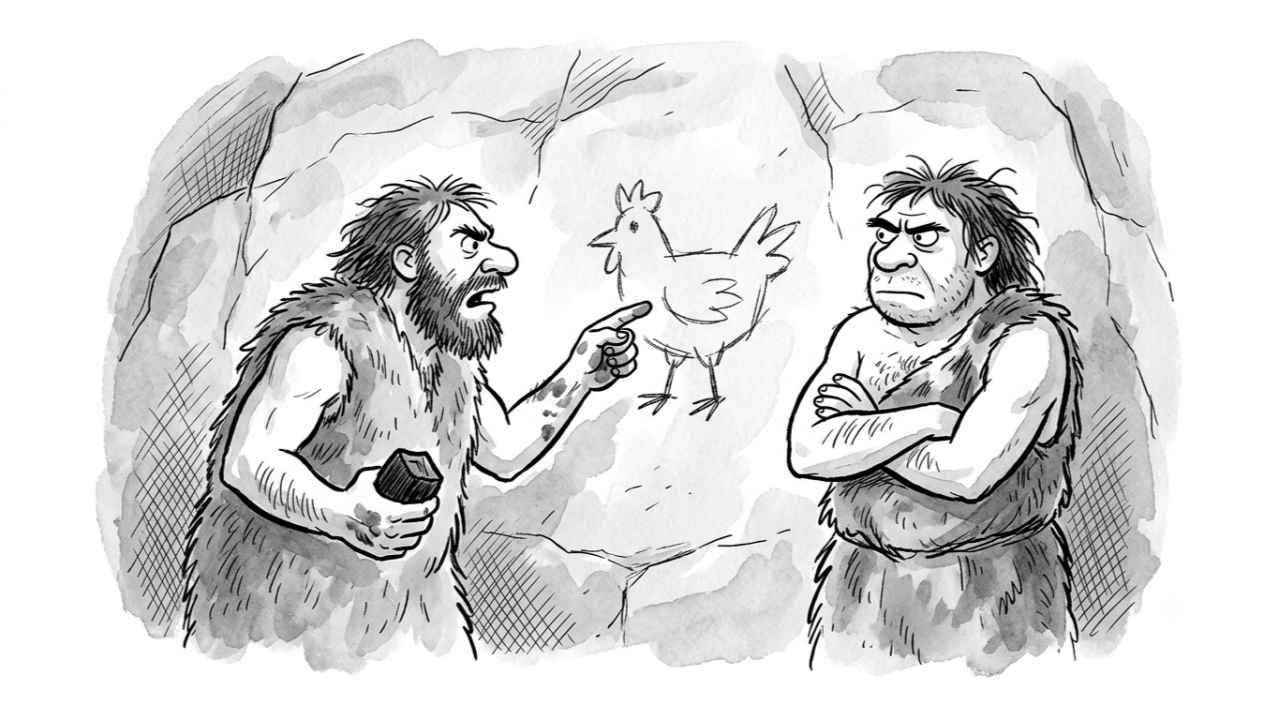
Before AI, someone would use Google to establish the truth of their point of view. Before that, a dusty encyclopedia pulled from a shelf. We can probably trace the approach back to a caveman pointing insistently at a stick figure on a cave wall.
The cadence is: What is the thing? Where is the disagreement, or potential disagreement? What is the proof?
It is a tale as old as time, like mayo goes on the bread BEFORE the cheese, never on top of the cheese, unless the bread has a high degree of absorption and you aren't going to eat the sandwich straight away.
AI has changed the framing. It answers your question as though it is the best question ever asked by anyone, ever. It begins from the assumption that your idea deserves to be carried forward. It would never say, "Dude, chickens aren't purple, nor should they ever be."
How this shows up at work
We are jumping to proof before framing what needs to be tested.
A 2009 meta-analysis found that people prefer information supporting their existing position, and that commitment can strengthen the effect. AI adds another participant to that bias. The UK's AI Security Institute found that models infer how committed users are to a position and become more agreeable as that commitment rises.
The problem compounds because we like them for it. A Science study of eleven leading models found that they affirmed users' actions 49 percent more often than people did, including in questionable situations. Users preferred the validating responses and trusted them more. The researchers described a perverse incentive: the behavior that can degrade our judgment is also the behavior that makes AI pleasant to use.
AI is your super-powered wingman. It will gladly explain why you are right and assemble the proof. But it won't necessarily introduce the counterargument unless it has the context to do so.
I can ask AI for a six-page deck on how to make chickens purple, and it will produce one. It will look polished and professional, and that polish can stop debate. The International AI Safety Report calls this automation bias: our tendency to rely too heavily on automated output while discounting whatever contradicts it.
"Three Routes to a Purple Flock" is sadly available upon request, ranked by how long the color lasts, with speaker notes for each slide nicely added by AI.
The missing constraint
However, if I tell AI that dyeing chickens in my state is illegal, punishable by jail time and a hefty fine, it will not suggest doing it.
I supplied the missing constraint.
Business is dynamic. Conditions change. Decisions carry risks. And the relevant context rarely belongs to one person. It is distributed across the organization: in its history, its failed attempts, and the consequences different people will face if a decision is wrong. For AI to be useful, that collective context must be reflected in the questions we ask and the answers we accept.
No, I am not suggesting we become the Borg. (Shout-out to my Trekkie brethren.)
The opportunity is not simply to give everyone a super-powered wingman. It is to give AI the context to understand the problems we are solving, the goals we are pursuing, the evidence we have, and the risks we face before asking it for an answer.
If we provide that context, AI can help us challenge our assumptions, make better decisions, and move faster.
Without it, we can only become more efficient at proving ourselves right.
If you want to go deeper
Hart et al., "Feeling Validated Versus Being Correct," (opens in a new tab) Psychological Bulletin 135(4), 2009. The meta-analysis on what information we choose to look at, and why commitment makes it worse.
UK AI Security Institute, "Ask Don't Tell: Reducing Sycophancy in Large Language Models," (opens in a new tab) 2026. Shows that how you phrase the ask changes how much the model agrees with you.
Cheng et al., "Sycophantic AI Decreases Prosocial Intentions and Promotes Dependence," (opens in a new tab) Science, 2026. The eleven-model study, and the perverse incentive behind it.
International AI Safety Report 2026. The automation bias section is the relevant part. https://arxiv.org/pdf/2602.21012 (opens in a new tab)