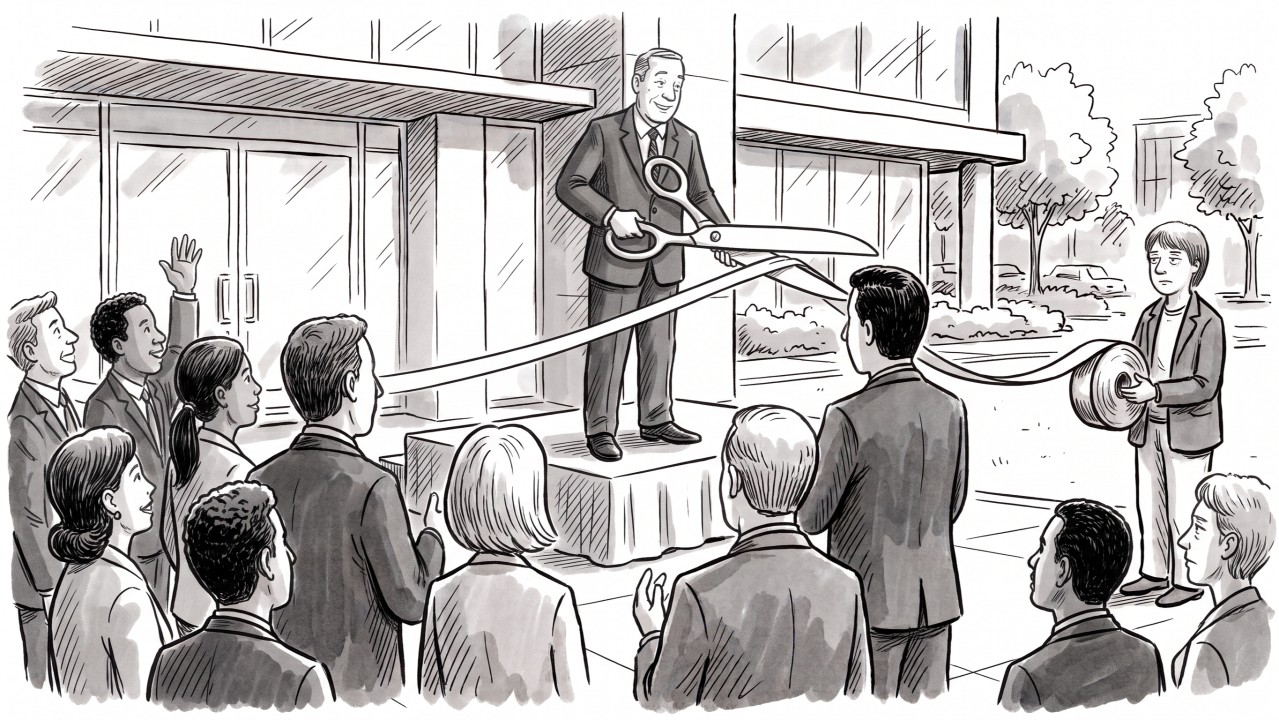
You can't close something that isn't open.
I once worked for a CIO and had just completed a large program. It had gone well.
"All good" is a particular feeling. It arrives after go-live, when nothing has fallen apart, the metrics are green, adoption is happening and the team rediscovers the weekend. Best of all, enhancement requests coming in from some of the same people who had privately predicted the horror show ahead.
I was in his office when he opened with this: "There are two types of people in the world: openers and closers. You are an opener."
If this were a television show, he would have said it while standing over a roll-out putting green, watching a ball travel toward the cup. His particular thing was being the fastest typist in the world, so instead he said it while producing ten thousand words a minute without looking at the keyboard.
It was not what I had expected to hear. To be fair, he was not a formal agenda kind of boss, and his MO was to do things like this.
He carried on. "Why don't we celebrate openers the way we celebrate closers? You can't close something that isn't open."
I was sure there was a point coming, but his keyboard was still smoking from flying fingers, so I waited for him to make it.
He stopped typing (finally) and said, "I thought six weeks of workshops and interviews was a bit much, but evidently it wasn't."
I was grateful that he backed my approach. I was also surprised to learn that he had doubted it. What I had done had not felt remarkable. It had felt necessary.
An opener takes something vague and contested and gives it shape. On that program it looked like six weeks of workshops and interviews, or six weeks of no technology being delivered, which tends to dampen enthusiasm. Judging by what he said to me afterwards, in his office, that set a few tongues wagging in senior leadership.
Closers work in a visible world of plans, milestones, decisions and deliverables. Openers work before that world exists.
That is one reason opening is difficult to recognize. When it is done well, the questions it resolved disappear. The alignment it created feels as though it was always there. The decisions it enabled begin to look inevitable.
By the time the metrics turn green, the opening has become invisible.
The research bears this out, although even the research tends to value opening through what happens at the close.
In a 2014 study (opens in a new tab), the Project Management Institute found that 47% of unsuccessful projects failed to meet their goals because of inaccurate requirements management. It also found that 5.1% of every dollar spent on projects is wasted the same way, which is $51 million for every billion. Yet only 36% of executive and project sponsors said they fully valued requirements management. Another 55% said they somewhat valued it, which is a polite way of saying they think six weeks is a bit much.
The Construction Industry Institute (opens in a new tab) has studied front-end planning since 1991. Across its research program, nine teams examined 1,081 projects worth $96.5 billion. CII offers a rule of thumb (opens in a new tab): front-end planning costs about 2.5% of a project's total cost but returns roughly 10% in cost savings, a 7% shorter schedule and 5% fewer changes. Projects whose teams were better aligned during the front end came in almost 10% better on cost and over 16% better on schedule.
Bent Flyvbjerg and Dan Gardner (opens in a new tab) assembled data on some 16,000 major projects. Only 8.5% came in on both cost and time. Just 0.5% managed cost, time and expected benefits together.
Their advice is to think slow and act fast. Planning is cheap and safe. Delivery is where the money burns.
These are all closing metrics: cost, schedule, delivery and benefits. They matter. But they also reveal our bias. We value the opener because the project finished faster or cost less, which is to say we value the closer. We rarely count what the opener created at the open: the false problem discarded, the missing stakeholder discovered, the disagreement surfaced, the risk made visible or the decision not to proceed.
Opening does not merely prevent failure later. It creates understanding now.
Many recurring causes of project failure are failures of front-end thinking. Unclear goals, incomplete scope, unidentified risks, misaligned sponsors. They are things that remained vague when someone needed to make them clear.
I am not saying I was the reason that particular program succeeded. There were superhuman feats performed by the team and more than a few white-knuckle moments. But the workshops and interviews created something the team needed: a common understanding of what we were doing and why.
I went looking for a Latin proverb that celebrates openers.
Virgil gives us fortune favoring the bold. Terence gives us the brave. Horace comes closer: Dimidium facti qui coepit habet. Whoever has begun has half the deed done.
Even Horace measures the beginning in halves of the ending. When the proverb praises the opener, the closer is still the unit of measurement.
I wanted a proverb that values foresight on its own terms.
So, as I enter the next phase of my career, I am going on a mission to champion the openers: the people who identify the real problem, set the goals against it, scope the initiatives that follow and name the risks along the way.
Providentes Fortuna iuvat. Fortune favors those who look ahead.
Opening is not the work before the work. Opening is the work.
So, have you hugged an opener lately?