I once went to a finance person to ask for money. I wanted to prevent something. I could see it coming, I had seen it before, and I knew roughly what it would cost us when it arrived.
I asked why. He said I could not tell him for certain that the thing was going to happen, so why would he spend money on it. (Why do creatives have to go to finance for money, when finance never has to come to creatives?)
It took me a while to realise he was not just saying no. He was picturing himself asking his boss to approve a budget where the only outcome he could point to was the thing not happening.
He was not judging the risk I had identified. He was judging his chances of defending it.
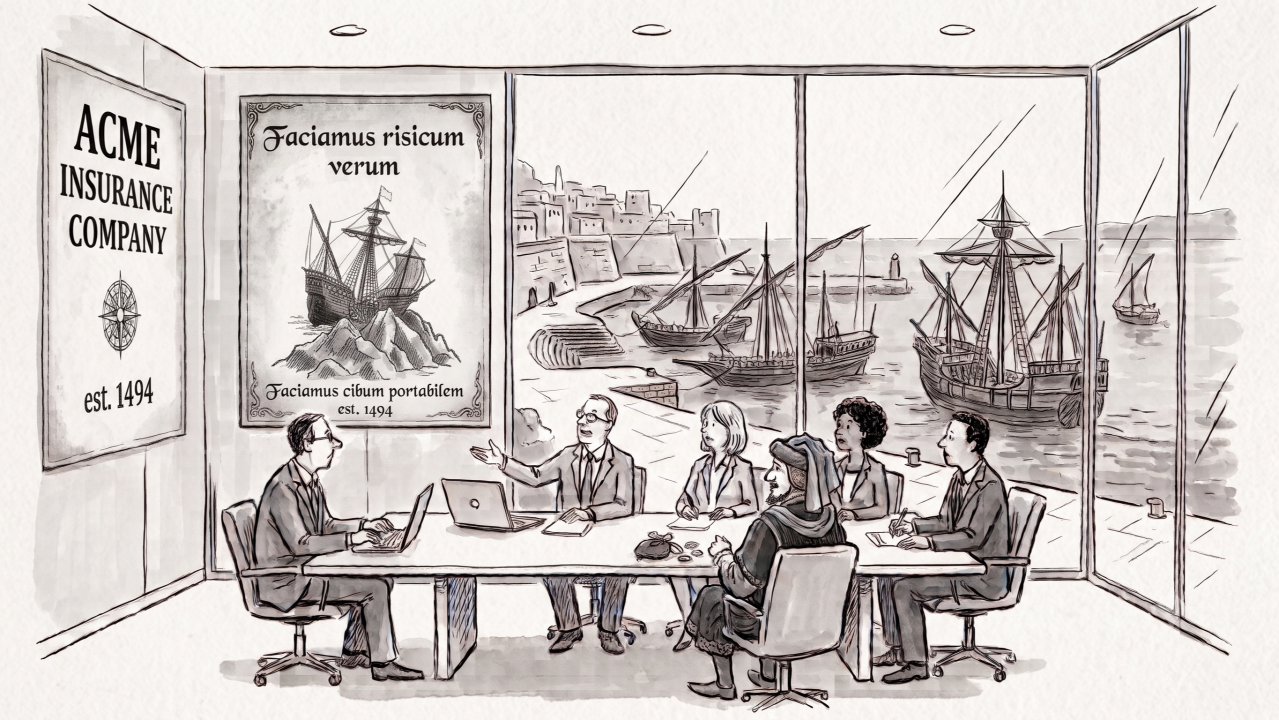
Risk: a condition that has not yet affected the work, but could, and that you can still act on. The word came into English through French and Italian. Thirteenth century merchants and marine insurers used it to name the dangers to goods being carried, things like a rock in the ocean that a ship might hit, and whose loss it was if it did.
Issue: a condition that has already affected the work. Through French from the Latin exire, to go out. As in, we have an issue, my ship hit a rock.
I could have just waited. Once the risk I had identified became an issue I would have had something tangible to hang a budget against, and nobody would have questioned the spend. It would have cost a lot more to fix at that point, but it would have been the easier way out.
Instead I took the time to talk about it. I wanted the risk to be common knowledge.
It is not enough for everyone to know something separately. To act together, people need to know that the others know it, and that the others know they know. Game theorists call that common knowledge.
Two of us knowing did not get it done. The finance person would still have been alone when he took the request upward.
After I had made my rounds, I asked again, and got the budget.
Nothing about the risk had changed. Not the odds, not the cost. What had changed was who knew about it.
Getting agreement takes time. Somebody has to have heard of a thing before you can ask them to pay for it, and somebody above them has to have heard of it too. This is also known as politics, if you were wondering. It is really just the time it takes for something to become known.
Before I worked in tech I worked with my family in my dad's restaurant in Toronto.
Nobody in that kitchen ever used the word risk. What we did was prep.
You come in hours before anyone eats and you get everything ready for orders that have not been placed. Onions cut, stocks on, sauces held, every station laid out so that when a ticket lands you can start it without looking for anything. It is called mise en place, which just means put in place.
Once service starts there is no time to look. Every second spent hunting for something is a table waiting.
And unlike most business situations, when you get it wrong it is obvious in real time. Prep too much and you throw food out. Prep too little and the service falls apart, which brought out quite colourful language from my otherwise very calm father.
If you have seen The Bear you will know that nothing in a kitchen happens silently. Everything is called out and everything is answered, because a cook who is guessing about what the person next to him is doing is about to burn something.
Escoffier had been an army cook, and he codified the kitchen brigade in Le Guide Culinaire in 1903. Work divided, responsibilities clear, and the preparation done before the pressure arrived.
Next time you eat out, that is what is happening in the kitchen. It is just risk management.
Three researchers in the Netherlands spent years asking whether risk management actually helps IT projects succeed.
First they reviewed the empirical literature. There was plenty on why IT projects fail, and almost nothing showing that any of it was being used to run projects better.
They dug deeper and went back to the source of the studies. They looked at seven ERP implementations and interviewed the people involved, and found that risk management was doing something other than calculating and controlling. It was changing how people understood the situation, what they expected of each other, and who felt responsible for acting. Stakeholders rated risk identification the most influential activity.
Then they ran an experiment, and found that just identifying risks, on its own, made projects go better. What made it work was having a common thing to talk about while they did it.
Which is what happened to me. I did not win that budget with better analysis. I won it by making sure everyone acknowledged the risk first.
I propose we make a mantra of it. Make risk real.
Bring it to every meeting and ask the question, over and over. Not to measure against metrics, but to look ahead and make sure we are all seeing that rock while there is still time to steer.
T-shirts are available on request, bearing the mantra in the original Latin, Faciamus risicum verum. Nobody will know what it means, which is roughly the position most risks are in before someone bothers to explain them.
Karel de Bakker, Albert Boonstra and Hans Wortmann, "Does risk management contribute to IT project success? A meta-analysis of empirical evidence," (opens in a new tab) International Journal of Project Management, 2010. The review that found the evidence inconclusive.
Karel de Bakker, Albert Boonstra and Hans Wortmann, "Risk managements' communicative effects influencing IT project success," (opens in a new tab) International Journal of Project Management, 2012. Seven ERP implementations, in which stakeholders rated risk identification the most influential risk management activity.
Karel de Bakker, Albert Boonstra and Hans Wortmann, "The communicative effect of risk identification on project success," (opens in a new tab) International Journal of Project Organisation and Management, 2014. The experiment with 53 project groups.
Michael Suk-Young Chwe, Rational Ritual: Culture, Coordination, and Common Knowledge, Princeton University Press, 2001. Why it is not always enough for everyone to know. The concept was formulated independently by David Lewis and Morris Friedell in 1969.
Elizabeth Morrison and Frances Milliken, "Organizational Silence: A Barrier to Change and Development in a Pluralistic World," (opens in a new tab) Academy of Management Review, 2000. Why people who have noticed something say nothing.
Auguste Escoffier, Le Guide Culinaire, 1903. The brigade is why The Bear has a storyline, and why a restaurant can put a menu in front of you and have everyone order at different times.