Have you ever walked naked across a suspension bridge, lined with people applauding your every step?
Neither have I, at least while awake that is.
But picture it. The bridge lined with everyone you work with, cheering you on, encouraging you to walk across that bridge buck naked. What would it take? What would have to be waiting for you on the far side to make you do that?
That thing is your reason for doing a pretty risky (or risqué) thing.
How often while chasing that reward, would you turn around and look behind you instead of forward, trying to make sure you don't fall through the massive hole that just opened up in front of you?
Ummm, if any psychologists out there could please reach out to help me understand why I am having this dream...
While we wait for the psychologists to call 911, let's all agree that we are traversing that bridge every day at work, fully clothed, but with the same exposure. We are there to bring ideas and solve problems for our employers. But, and it is an important but, for a lot of us it is by reporting what we have done, not what is stopping us on the road ahead.
I once worked for someone who took a year off to sail around the world. He came back with stories. Most of them I cannot repeat here.
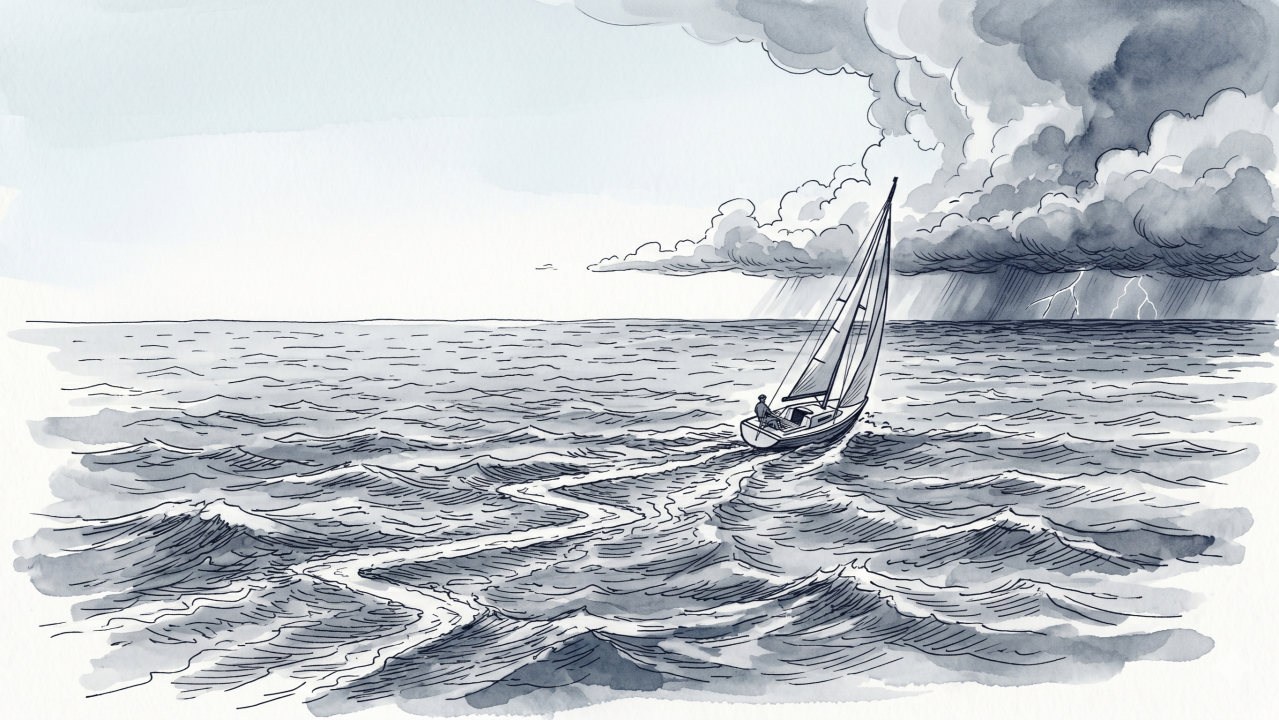
One that I can repeat, and matters for this piece, is that he told me how he traversed the ocean. Most importantly, that you don't get anywhere in a straight line.
I am not a sailor, so forgive the lack of technical precision here, but you tack. The wind decides. You set a heading, the world pushes back, you adjust, and you adjust again, and somewhere across a thousand corrections you arrive.
And here is the part that matters: you do not think about your last tack. You think about your next one.
The wind has already done what it is going to do. The only question that matters is what you do next.
That is managing risk. If we don't tack, we lose the wind. If we decide not to tack, we miss what happens later in St Kitts.
At work, we somehow turned that into a retrospective art project. Our version of watching the wind is called the dashboard.
We spend enormous amounts of time deciding the exact right balance of red, yellow, and green, carefully aligning arrows and status indicators to explain where we already are. Then we package it into presentations for people who will spend fifteen seconds looking at it before moving to the next slide.
And while we are complaining, why does one arrow always look misaligned when you export to PDF for the pre-read?
This is something organizations wrestle with constantly. How do we show everyone we are doing the right things while also staying aware of what is coming that might stop us?
The dashboard does neither thing well. It performs competence in retrospect and gestures vaguely at the future without actually preparing for it.
PMI's data on this is brutal. Organizations that build real risk conversations into the actual work complete dramatically more projects successfully than the ones that treat risk as reporting theater. The difference is not talent. It is not strategy. It is whether the team is looking forward, or cataloguing the wake.
A risk you do not name becomes an issue you cannot avoid. The register is not what saves projects. The conversation is.
Imagine the meeting where, instead of confirming everything is on track, the lead asks what is keeping people up at night. Three things come up that are not on the deck. Two of them get handled the same week. The third becomes the most important conversation the project has all quarter. And nobody had to spend six hours building the slide nobody was going to read carefully anyway.
So take the status report and turn it upside down. Start with one question:
What is stopping you, or slowing you down?
If you are wondering who to blame for status reports, the honest answer is the British Empire. They invented most of this. Colonial governance, the carbon-copied dispatch, the daily situation report.
A note on the research.
The research on this is overwhelming. If you want to go deeper, here is a select few things to start with.
The Project Management Institute (opens in a new tab) has been studying risk management and project outcomes for two decades, and their Pulse of the Profession series is the cleanest entry point.
The Standish Group's CHAOS reports are the most-cited source on technology project success rates. Their 2020 report found that 66% of technology projects end in partial or total failure across 50,000 projects studied. Large projects succeed less than 10% of the time.
The McKinsey and University of Oxford joint study on large IT projects, Delivering Large-Scale IT Projects on Time, on Budget, and on Value (opens in a new tab), is the source for the finding that large IT projects deliver, on average, 56% less value than predicted.
For the cultural pattern of green dashboards hiding red projects, Rob Lambert wrote the original essay on watermelon reporting, green on the outside and red in the middle.
If you want only one thing, read the PMI work. It connects the conversation about risk to the dollars at stake in a way that is hard to look away from.