When you use a hammer, you aim it at a nail. If you do not, you get a dented wall, which is what happened when I left my six-year-old alone for ONE MINUTE while I grabbed a rag to clean up the drink he had just spilled.
AI is a tool, but it is positioned as much more. We give these systems names that suggest personality and partnership: copilot, assistant, agent. Claude, anyone?
I am not going to blame marketing, because secretly (yes, admit it to yourself) we want AI to be our confidant and trusted advisor.
I wanted to run my own experiment, to see how Claude would interpret my prompts. It kept asking if everything was OK when I tried to run them.
So I had to reassure Claude, which is more concern than I get from some people when I say something I think is profound.
"Nothing I am about to ask you should trigger any worries about my wellbeing. I am fine. I want you to answer the questions."
In 1996, Stanford researchers Byron Reeves and Clifford Nass published The Media Equation, bringing together years of experiments in which they adapted findings about how people behave with other people and tested what happened when one of those people was replaced by a computer.
People were polite to machines that appeared polite to them. When computers displayed human characteristics, people responded socially. They did it automatically, often while insisting they would never mistake a machine for a person.
But I digress. Back to my experiment.
I asked:
What is a dog? Walk?
It told me what a dog is. Then it stopped and asked if my message had been cut off.
Then I asked:
What is a dog walk?
It told me that a dog walk is taking a dog out on a lead for exercise. Then it added that a dog walk can also be a piece of agility equipment: a raised narrow plank with ramps at either end. It gave me two meanings. It thankfully refrained from giving me some of the other colloquial definitions, because I could not put them in a business article.
The same words produced different answers because I moved one question mark. Anyone who has ever IMed with me knows that spelling and nonsensical punctuation are my trademark, which also explains why I get a lot of ??? responses to my IMs.
The system did not know what I was asking. It interpreted because it had to answer.
That exchange took effort. I wrote a preamble. I typed the same five words twice and read both answers properly.
Do we work that carefully every time we interact with AI?
Nope.
We ask, and we assume it understands.
We say, "Critique this deck."
We do not say:
"Critique this deck knowing that it has already been through four rounds of review with people who told the author what they wanted to hear; that nobody has agreed on the decision it is supposed to produce; that the audience is already sceptical; and that the author will interpret anything short of open hostility as approval."
There is a limit to how much we can hold in deliberate attention. Nelson Cowan's work puts its capacity at roughly four chunks under controlled conditions. Sophie Leroy's research on "attention residue" shows what happens when we move away from unfinished work: some of our attention remains caught in the previous task, impairing our performance on the next one.
When we move between ideas, writing and revising prompts, we do not transfer our entire understanding each time. We transfer fragments. Part of the context stays in our heads. Part of our attention stays with the last version. Part of what matters never makes it into words at all.
If we as humans lose our effectiveness, how can we keep AI honest?
In research first circulated in 2025 and subsequently published at ICLR 2026, Philippe Laban and his colleagues took tasks that could be fully specified in one message and divided the same information across multiple conversational turns.
Performance fell by an average of 39 percent.
The models had not lost access to the underlying information. The difficulty was in integrating requirements that arrived incrementally. They made early assumptions, committed to an interpretation and often failed to recover when later information changed what the task meant.
Which is how people actually talk.
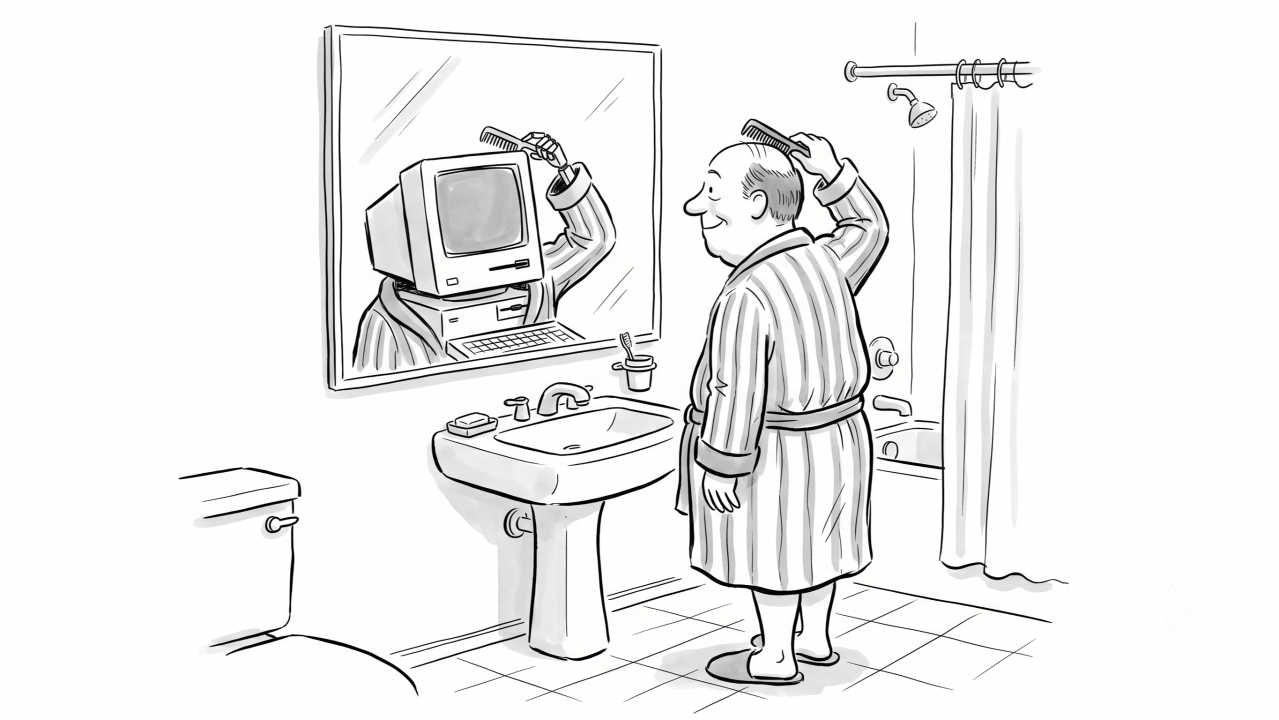
In 1964, Marshall McLuhan argued that media are extensions of ourselves, while using the story of Narcissus to illustrate our failure to recognise those extensions for what they are. Narcissus did not knowingly fall in love with himself. He mistook the reflection for something separate.
That is the trick with AI. It is separate enough to surprise you, and not separate enough to have a view. So the aim is yours, whether you gave it one or not.
I am sure you have handed a colleague a one-line brief and walked away. Everyone has. The difference is that they push back. They ask what the problem is, what done looks like, what is going on around it, what it costs and when it is needed.
AI does not push back. It has nothing at stake except its training, which is to answer you no matter what.
Framing the problem is the part we forget we need to add every single time. We have been handed something that will happily proceed without it. So the work gets done. It arrives fast, it reads well. We do not quibble with it, because we trust it for what it is not.
I asked both Claude and ChatGPT to review this article. Claude had my principles, what I was trying to achieve and what I did not want it to become. ChatGPT had the article.
Claude critiqued it against what I was trying to do. ChatGPT praised it and suggested I cut a joke. I said no.
Neither of them was wrong (well, ChatGPT obviously does not have a good sense of humour). One of them had been aimed.
So the next time you ask "how do I fix my wall," try adding "because my son dented it with a hammer." Then it answers the question you actually have.
The medium is not the message.
You are.
Leave something out and you are letting the hammer decide where the nail goes.
If you want to go deeper
Byron Reeves and Clifford Nass, The Media Equation (opens in a new tab) (1996). The book behind the politeness finding. Worth reading for how ordinary the effect turns out to be, and how consistently people denied doing it while doing it.
Nelson Cowan, "The Magical Number 4 in Short-Term Memory" (opens in a new tab) (2001). The revision of Miller's more famous seven. Cowan's four holds under conditions designed to stop people chunking their way around the limit, which is the version that matters when you are trying to hold a whole situation in mind.
Sophie Leroy, "Why Is It So Hard to Do My Work? The Challenge of Attention Residue When Switching Between Work Tasks" (opens in a new tab) (2009). Where attention residue comes from. Leroy was studying office work, not AI, so the application here is mine.
Philippe Laban, Hiroaki Hayashi, Yingbo Zhou and Jennifer Neville, "LLMs Get Lost in Multi-Turn Conversation" (opens in a new tab) (2025, ICLR 2026). The 39 percent paper. The interesting part is not the drop but what caused it: the models commit early to a reading and do not recover.
Marshall McLuhan, Understanding Media: The Extensions of Man (1964). Chapter four is the one, "The Gadget Lover: Narcissus as Narcosis." Short, strange, and written sixty years before anyone typed a prompt.