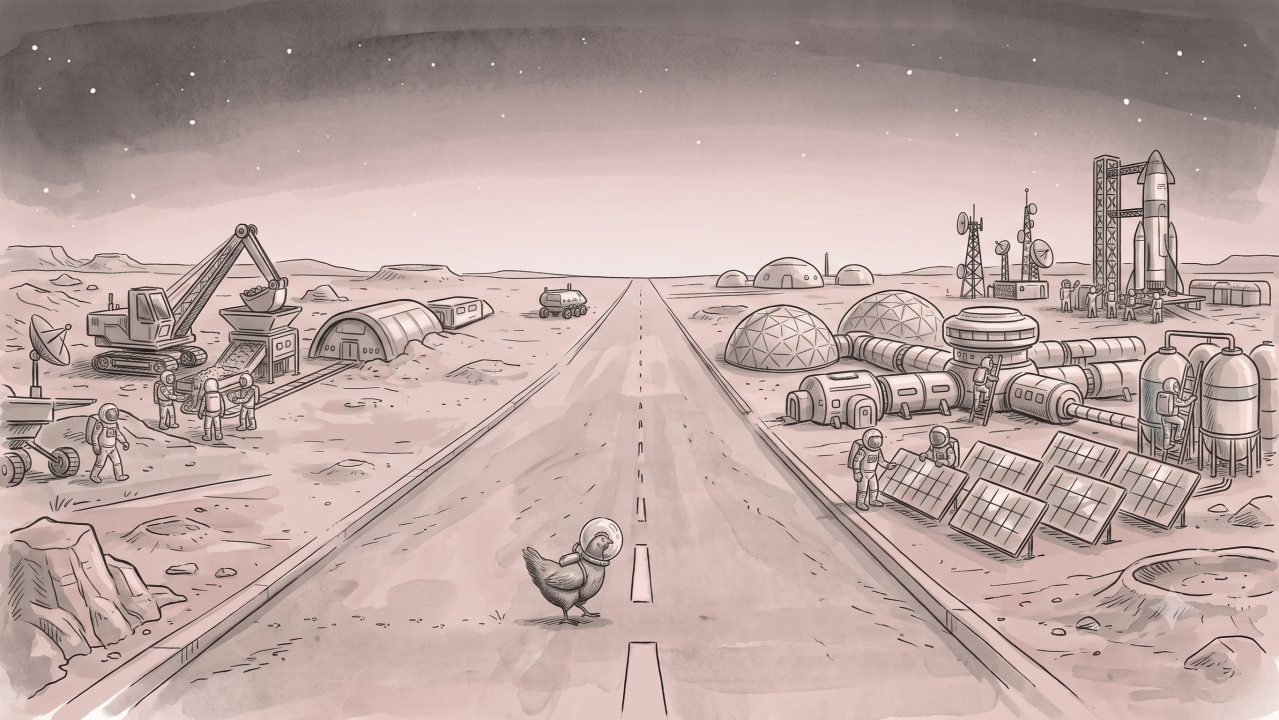
To get to the other side.
If you aren't five years old reading this, here's one for you:
A man woke up at three in the morning to loud knocking on his front door. He stumbled downstairs, opened it, and found the porch empty. Then he looked down and saw a snail on the welcome mat. Annoyed at having his sleep ruined, he picked it up and hurled it as far as he could into the front yard.
Three months later, another knock. He opened the door, and there was the same snail, completely out of breath. It looked up and said, "What the hell was that all about?"
Both are absurdist humor. Your brain reaches for the answer, the way it does with any joke, and finds there isn't one. You use logic to conclude there is no logic, and that is what makes you laugh. And if you've spent any length of time in corporate America, absurdist humor might feel apt.
Your brain solved dozens of problems before breakfast without you realizing it. You drove to the gym without hitting a tree, a cyclist, or the person who brakes at every yellow light. You stopped at the bank because the farmers market is Saturday and half the stalls still don't take cards. You ran out of coffee, so you made more. (This article owes its existence to some small-batch fair-trade coffee from Colombia. No, they didn't pay for placement.)
We arrive in this world this way. A nine-month-old will pull a blanket to drag a toy closer, or shove your hand aside to reach something interesting. They will drop a spoon from a highchair, then do it over and over, partly to make a problem to solve and partly because they have discovered they can keep an adult's attention. Nobody teaches this. We are factory-equipped to spot (or, as adults, sadly create) a problem and start working toward a solution.
It is human nature. We spot problems and set goals to close them. It is so part of us we don't even notice we are doing it.
We are so attuned to it that when the problem is outside our own expertise, we ask for help.
Andy Weir built a novel on exactly that.
The Martian, which became a movie starring Matt Damon, began as a story serialized on Weir's website, one chapter at a time. Weir is a programmer, not an expert on surviving on Mars, and his story depended on getting it right. So his readers helped. Thousands of them. One corrected the orbital math. Another pointed out that one of Mark Watney's clever chemistry tricks would have quietly poisoned him inside his own habitat. Every chapter became a group effort to achieve the goals that solved the core problem: how to stay alive long enough to make it home. Weir gave Watney a line that didn't make the film: "Every human being has a basic instinct: to help each other out."
From there, it's just goals, one after another, refined and achieved, until the problem is solved. Or, as Watney puts it in the film, "I'm gonna have to science the shit out of this."
Somewhere between the highchair and the conference room, this stops working. Why?
Teams rarely fail because the problem is too hard. They fail because they stop thinking about the problem. Attention shifts to solutions, and they forget there was a problem to solve.
In a Harvard study of 106 executives across 91 companies, 85 percent admitted their organizations are bad at diagnosing problems. Not solving them. Diagnosing them. A separate study of 358 corporate decisions found that more than half failed, most often because people felt too rushed to examine the problem before attacking it.
It seems everyone jumps right to a solution. Once work begins, nobody wants to revisit the original problem because doing so might prove the work unnecessary, or wrong. So we end up protecting the solution instead of testing whether we're solving the right problem. That's exactly backwards. (This is the absurdist part, if you were wondering.)
None of this is how we start out. The nine-month-old doesn't protect a solution. If dragging the blanket doesn't bring the toy, she drops it and tries something else.
We seem to adapt to the absurd later, at work, where having an answer is rewarded and questioning one feels like heresy. Psychologists have a name for the behavior, functional fixedness. It is not in our wiring. It is trained on top of it.
Which brings us to one of the most uncomfortable questions you can ask in a meeting.
"What problem are we solving here?"
Watch what happens if you constantly keep the problem in frame. Goals start to emerge. Work gets defined in the context of the problem. And risk becomes something to be managed, like the chance I miss deadline on this article. Managed, in this case, by making more coffee. Risk comes down to a simple question: what is stopping us from solving this problem?
That question shouldn't feel revolutionary. A nine-month-old asks it instinctively. A programmer accidentally built a bestselling novel around it. It's one of the oldest instincts we have.
So ask it. Out loud. And keep asking it. If a chicken can figure out why it crossed the road, surely we can figure out why we're in the meeting.
If you want to go deeper
The Martian by Andy Weir. Not just a good read. Watch how a stated problem pulls goals, help, and course-corrections out of a crowd of strangers.
Are You Solving the Right Problems? (opens in a new tab) — Thomas Wedell-Wedellsborg, Harvard Business Review. The 85 percent study, and the case that we're trained to jump at solutions before we understand the problem.
Paul Nutt, "Surprising but true: Half the decisions in organizations fail," (opens in a new tab) Academy of Management Executive (1999). The 358-decision study. Half fail, most often because managers grab the first solution instead of examining the problem. Expanded in his book Why Decisions Fail (2002).
Paul McGhee on children's humor. Why a five-year-old laughs at the chicken and you don't, and why we stop finding the same jokes funny once we can solve them too easily.
The research on infant problem-solving — Willatts on eight-month-olds working out how to reach a toy, Woodward on babies reading goals before they can talk. The evidence that this is native, not taught.
George Defeyter and Tim German on functional fixedness in children. We start out flexible and get more rigid with age, not less.